A fractal is an object that is similarly shaped at different scales. Think of a tree: The small branches look like the big branches, and the big branches look like the whole tree.
The stock market works the same way.
Financial prices fluctuate as a fractal, with a comparable style of movement on all time scales, from seconds to centuries. This is a model of a dynamic marketplace, not a stable one.
The illustration below shows R. N. Elliott’s idea of how the stock market is patterned. Note that each component, or “wave,” within the overall structure subdivides in a specific way. If the wave is heading in the same direction as the wave of one larger degree, it subdivides into five waves. If the wave is heading in the opposite direction as the wave of one larger degree, it subdivides into three waves (or a combination thereof). Waves subdivide this way down to the smallest observable scale, and the entire process continues to develop larger and larger waves as time progresses.
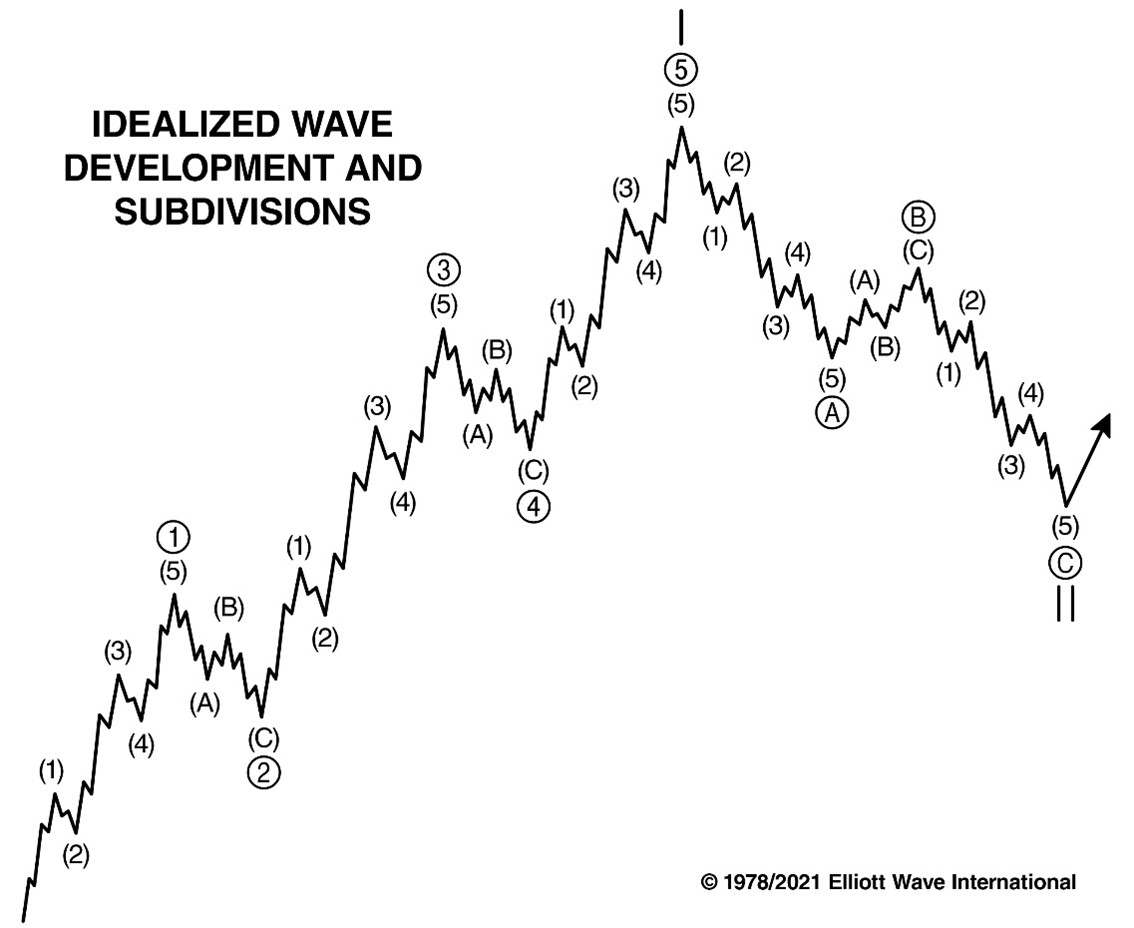
Understanding how the stock market progresses at all degrees of trend gives you an invaluable perspective. You stop chasing headlines and economic data points. And you start seeing the shape of what’s next.
Want to see how we use stock market price patterns to anticipate market moves? Subscribe now.
Or, learn more about the Wave Principle with our free Elliott Wave Essentials Guide.