When Japanese government bond yields suddenly surged last week, the financial media dragged out the usual suspects — new leadership, fiscal expansion, even a snap election.
Those lazy, all-too-common explanations miss the bigger point:
Japanese bond yields didn’t start rising last week. This move has been building for years.
And now the world is finally catching up.
After Japan’s bonds crashed, Bloomberg reported that traders were stunned by “the speed and breadth of it all.” One fund manager pointed to a quarter-point surge in yields “in a single session” and said: “Let that sink in.”
For investors, this wasn’t just noise — it looked like something more ominous: panic in the monetary system.
The First Signal Came Before Most Were Paying Attention
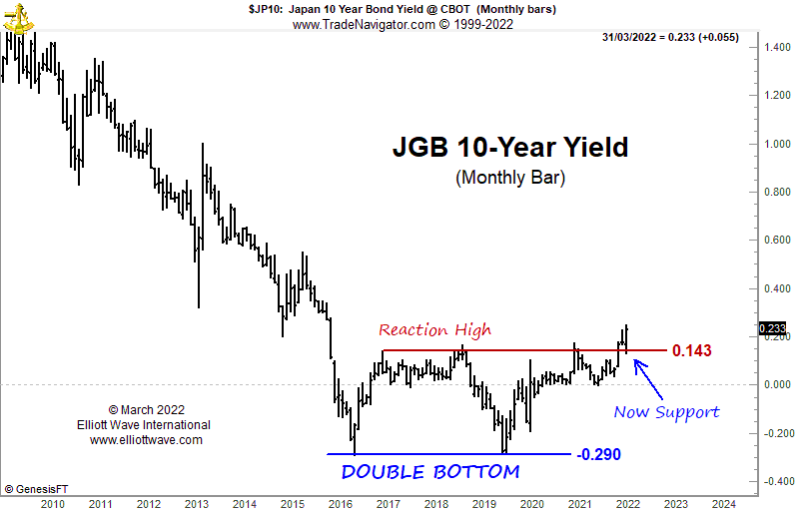
As far back as March 2022, Elliott wave analysis was already identifying a potential long-term turning point in Japan’s bond market.
Elliott Wave International’s Head of Global Research, Murray Gunn, alerted subscribers to a developing double-bottom in the Japanese Government Bond (JGB) yield, highlighted by a move above a key reaction high near 0.14% and supported by expanding futures volume. When yields later pulled back, that former resistance held as support — a classic “trend-ending” behavior.
As Murray noted at the time:
“This re-test of a break is another example of a ‘kiss goodbye’ that often marks the end of a long-standing trend.”
— Elliott Wave International, March 2022
Central bankers, of course, dug in even deeper, arguing that Japan’s yield-control regime made higher yields impossible. Reality, aka actual Japanese yields, had something else in mind:
“Conventional thinking would conclude [yields cannot rise]. However, this chart is sending the opposite message.”
— Elliott Wave International, March 2022
What We Said Next — Before the Breakout
A few months later, in July 2022, Elliott wave analysis became even more direct:
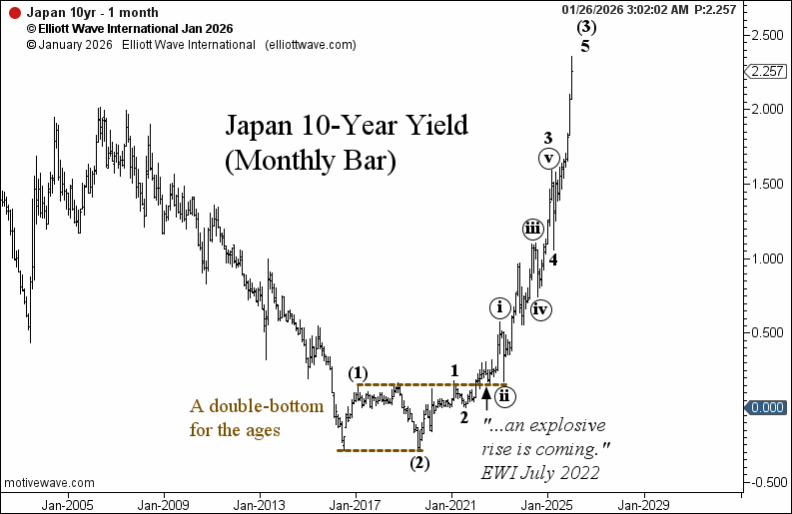
“An explosive rise is coming.”
— Elliott Wave International, July 2022
That wasn’t based on politics or policy speculation. Murray’s forecast came from the price structure itself.
At the time, Japan’s 10-year yield was still around 0.17%, a level many believed would persist indefinitely.
Since then, yields have skyrocketed:
NOW They Notice?
Bloomberg warns this isn’t just a Japan story anymore. It’s becoming a global risk factor.
One Japanese asset manager put it bluntly:
“It’s a new era… This is just the beginning — there’s a chance that bigger shocks will happen.”
— Masayuki Koguchi, Mitsubishi UFJ Asset Management (via Bloomberg)
The bigger issue isn’t simply that Japan’s yields are rising. It’s what rising Japanese yields can force elsewhere — through global rate repricing, currency volatility, and the unwinding of positions that depended on Japan staying the world’s “cheap money” engine.
Which raises a sobering question:
Is this the first sign of unraveling of global central banking?
Perspective Matters
Markets rarely announce major shifts with one dramatic headline. They telegraph them quietly — through price structure, sentiment, and long-term patterns – NOT lazy, conventional, after-the-fact blathering.
That’s why the March and July 2022 signals mattered. And it’s why developments like this deserve ongoing attention — not “the horse has left the barn” one-off explanations.
Our flagship publications track market patterns as they evolve, not years later. Which is more helpful to you?
Read our latest forecasts:

 Global Market Perspective
Get a monthly overview of interest rates along with 50+ other global markets.

 Interest Rates Pro Services
Get daily and intraday Elliott wave analysis of interest rates.
No headline forecasting. Just structure, psychology, and price — applied in real time.
OR
Not ready to subscribe?

Just buy a single issue
Grab a single issue and instantly read our most recent market analysis.