When the European Central Bank raises a financial-stability flag, it’s rarely trivial. These warnings often appear just before major market turns — and the latest one arrives as several U.S. and European indicators align in ways worth noting.
A Stress Gauge at Record Calm — and That’s the Problem
In October’s Global Market Perspective, EWI highlighted the sharp decline in the ECB’s Composite Indicator of Eurozone Systemic Stress — a broad, 15-component measure of credit, liquidity, and market tension. It has fallen from 0.74 in late 2022 to 0.02, essentially signaling no stress at all.
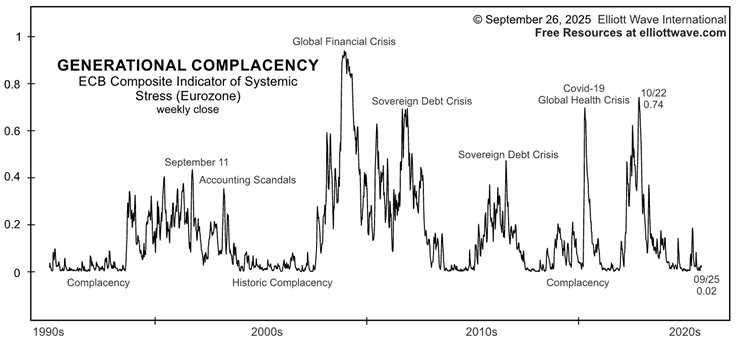
Historically, readings near zero have preceded:
- the late-1990s tech bust,
- the mid-2000s credit crisis, and
- the 2008 Global Financial Crisis.
This is why the ECB’s new warning stands out: they’re flagging rising vulnerabilities at the exact moment the indicator shows near-perfect calm.
That gap between official concern and market complacency has often marked the setup for major reversals.
As GMP put it:
“Today’s absence of any trace of financial unease is a perilous setup for stocks.”
When Central Banks Start Blinking Red, You Don’t Wait
Major market breaks typically share two conditions:
- Central banks sense trouble early.
- Investor optimism peaks just before the shift.
We’re seeing that combination again. One of the world’s most influential central banks is warning about fragility while its own stress gauge sits at multi-decade lows. That contrast alone argues for preparation, not passive optimism.
Use the “Calm” Wisely, Protect Yourself Now
Get Robert Prechter’s Last Chance to Conquer the Crash >>
Your roadmap for understanding and navigating major financial reversals.
Or download our FREE “Preparing for Difficult Times” report >>
A practical guide for reducing risk and strengthening your financial position.
Stay Ahead of the Turn
Market conditions evolve quickly. To stay aligned with trend and sentiment shifts, explore our flagship publications — The Elliott Wave Financial Forecast, The Elliott Wave Theorist, Short Term Update — or our global monthly, Global Market Perspective.